Rakesh Chopra is an SVP and Cisco Fellow in the Cisco Silicon Group. Since joining the company in 1997, Rakesh has played a critical role in developing Cisco’s hardware for Enterprise and Service Provider markets.
Today, Rakesh leads the Silicon One Architecture and Systems Architecture teams where he combines deep engineering expertise with an equally strong understanding of customer requirements. Whether working through complex technical challenges with a team of engineers or exploring real-world applications with customers, Rakesh brings the two perspectives together to identify market transitions, shape technology direction, and help ensure Cisco products and technologies reflect evolving customer needs.
Known for his technical depth and pioneering spirit, Rakesh is a highly respected authority in his field. In both customer engagements and industry events, Rakesh brings a practical and forward-looking perspective to how Cisco is helping organizations adapt their network infrastructure to meet the growing demands of AI.
Discover why network operators are turning to scale-across networking to meet the demands of AI traffic, why scale-across success requires converging silicon, systems, and optics, and how Cisco innovations are making it happen.
Cisco Silicon One has reached a pivotal milestone with the launch of the Cisco 8223—powered by Silicon One P200—delivering an unprecedented 51.2 Tbps capacity that sets the industry standard for the emerging "scale-across" era, where AI workloads must be distributed geographically due to power constraints that have become the primary limiting factor in AI scaling. This groundbreaking routing system uniquely converges routing and switching capabilities with unmatched power efficiency, advanced programmability, and uncompromising security—enabling hyperscalers to confidently architect distributed AI environments that seamlessly extend across broad geographical regions for sustained AI innovation and growth.
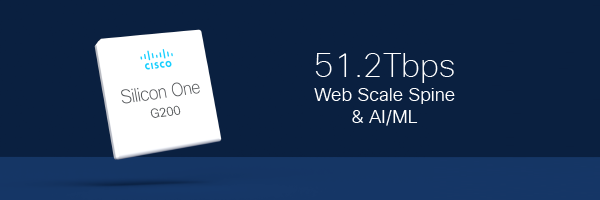
Today we expand the Cisco Silicon One™ portfolio with two new 5nm devices targeting web-scale spine roles and Ethernet-based artificial intelligence/machine learning (AI/ML) deployments. Cisco Silicon One devices now span from 3.2 Tbps to 51.2 Tbps, with a converged architecture and software development kit for true convergence without compromise.
Customers can deploy Cisco Silicon One to power their AI/ML networks and configure the network to use standard Ethernet, telemetry assisted Ethernet, or fully scheduled fabrics. As workloads evolve, they can continue to evolve their thinking with Cisco Silicon One’s programmable architecture.
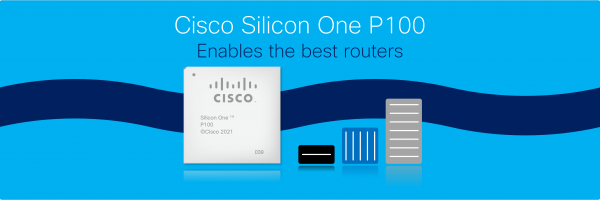
The Cisco Silicon One™ P100 enables the highest bandwidth and most efficient fixed box and modular routers in the world. Let’s look at how it stacks up.
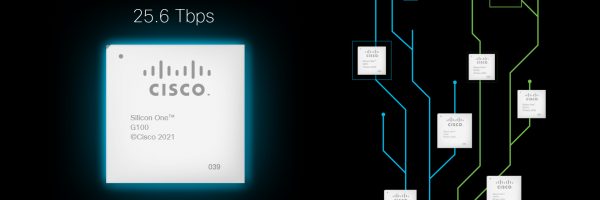
Today we expand the Cisco Silicon One portfolio with three new devices to include 25.6T and 8T web scale switching devices and an 8T routing device. With three new 7nm devices released in just five months from our last announcement, we continue to expand our network coverage at an unheard-of pace. All this with a fully unified architecture, SDK, and P4 forwarding code offers convergence without compromise!
The pace of bandwidth growth isn’t slowing down, and each generation draws more power than the last. To address this, the industry needs to move to co-packaged optics. Today we are announcing a collaboration between Inphi and Cisco to drive an open ecosystem around the technology.
Compare to other architectures, Cisco Silicon One can save up to 580kW of power in a web scale data center, fundamentally changing the economics of the industry. Web scalers can turn this into cost savings, increase revenue by adding more servers or help minimize their carbon footprint.